
Japanese Hiragana Chart
Hiragana is the first Japanese script learners meet: 46 basic characters that spell every sound in the language. This chart lays them out in the traditional order with romaji and stroke counts, lets you tap any character to hear it (using your device’s Japanese voice), and quizzes you until you know them all.
- Free to use
- No sign-up
- Runs in your browser
Hiragana chart and quiz
Quiz
Hiragana Practice Pack
Printable hiragana charts (basic, dakuten and combinations) with romaji, writing practice sheets for all 46 characters, flash cards and a hiragana reading quiz with answers.
- Hiragana chart (PDF)
- Dakuten and combinations (PDF)
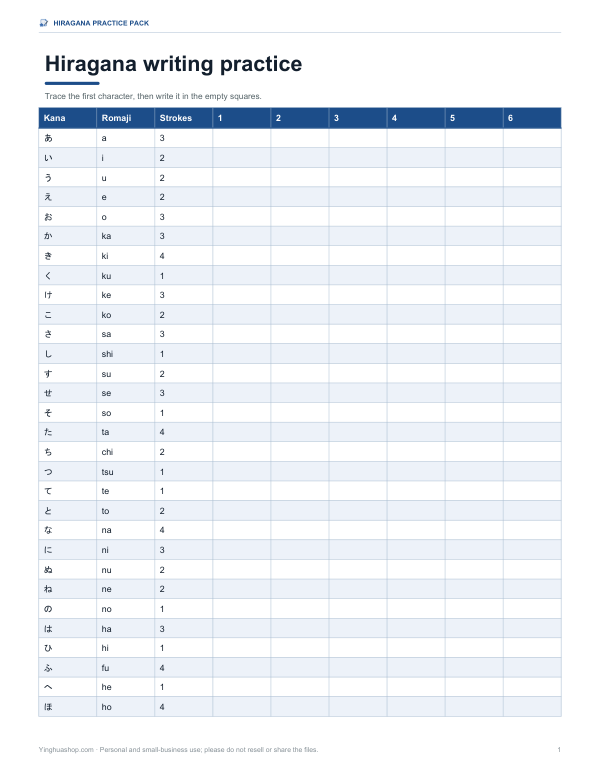
- Writing practice (PDF)
- Reading quiz (PDF/DOCX)
Formats: PDF, DOCX. Instant download after payment (link valid 72 hours, up to 5 downloads). AI-assisted: the templates were drafted with AI help and reviewed and laid out before publishing.
$5.00 USD, one-time 4 files · about $1.25 each
- Instant download
- 7-day refund
- Secure checkout by Stripe
7-day money-back guarantee. Full refund within 7 days of purchase, even after you download.
Free sample: Dakuten and Combinations (PDF, 106 KB)
Full refund within 7 days — see the refund policy and license.
Free printables
Single sheets you can print right now, no sign-up. The full pack adds every sheet in one download plus the editable files.
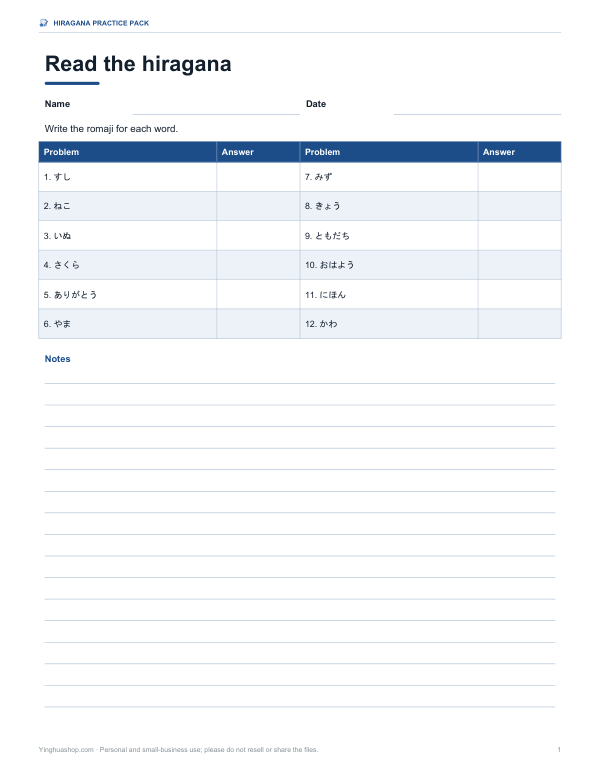 Printable Hiragana Reading Quiz
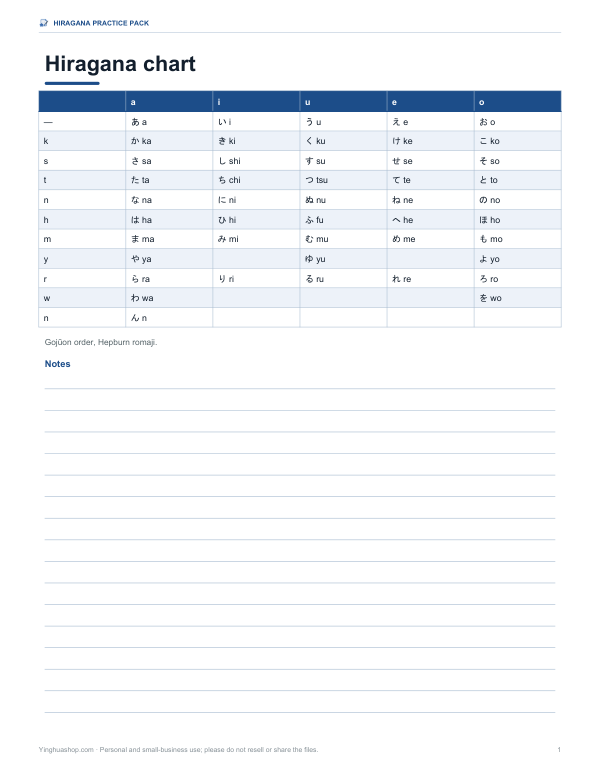
The basic hiragana chart
| Row | a | i | u | e | o |
|---|---|---|---|---|---|
| — | あ a | い i | う u | え e | お o |
| k | か ka | き ki | く ku | け ke | こ ko |
| s | さ sa | し shi | す su | せ se | そ so |
| t | た ta | ち chi | つ tsu | て te | と to |
| n | な na | に ni | ぬ nu | ね ne | の no |
| h | は ha | ひ hi | ふ fu | へ he | ほ ho |
| m | ま ma | み mi | む mu | め me | も mo |
| y | や ya | ゆ yu | よ yo | ||
| r | ら ra | り ri | る ru | れ re | ろ ro |
| w | わ wa | を wo (o) | |||
| n | ん n |
This is the gojūon (“fifty sounds”) order used in dictionaries. Romaji follows the Hepburn system, which spells sounds the way English speakers expect — し is shi, ち is chi, つ is tsu and ふ is fu. The particle は is pronounced wa, へ as a particle is pronounced e, and を is usually pronounced o.
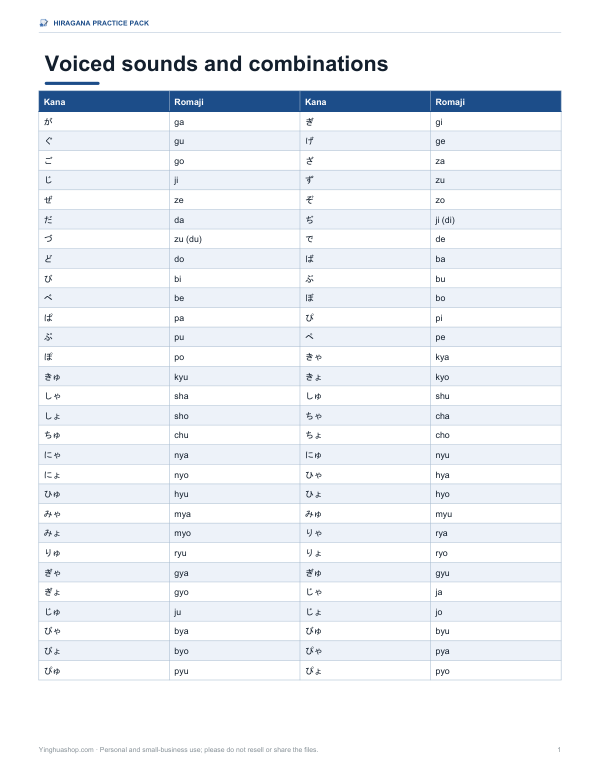
Dakuten and handakuten
| Base | With dakuten (゛) | With handakuten (゜) |
|---|---|---|
| か row (k) | が ぎ ぐ げ ご — ga gi gu ge go | |
| さ row (s) | ざ じ ず ぜ ぞ — za ji zu ze zo | |
| た row (t) | だ ぢ づ で ど — da ji zu de do | |
| は row (h) | ば び ぶ べ ぼ — ba bi bu be bo | ぱ ぴ ぷ ぺ ぽ — pa pi pu pe po |
The two small marks turn unvoiced sounds into voiced ones (k → g, s → z, t → d, h → b) and h into p. ぢ and づ sound the same as じ and ず and are used only in a few words.
Combinations (yōon)
| ゃ ya | ゅ yu | ょ yo | |
|---|---|---|---|
| き | きゃ kya | きゅ kyu | きょ kyo |
| し | しゃ sha | しゅ shu | しょ sho |
| ち | ちゃ cha | ちゅ chu | ちょ cho |
| に | にゃ nya | にゅ nyu | にょ nyo |
| ひ | ひゃ hya | ひゅ hyu | ひょ hyo |
| み | みゃ mya | みゅ myu | みょ myo |
| り | りゃ rya | りゅ ryu | りょ ryo |
| ぎ | ぎゃ gya | ぎゅ gyu | ぎょ gyo |
| じ | じゃ ja | じゅ ju | じょ jo |
| び | びゃ bya | びゅ byu | びょ byo |
| ぴ | ぴゃ pya | ぴゅ pyu | ぴょ pyo |
A small ゃ, ゅ or ょ after an “i” kana makes a single blended sound. A small っ doubles the next consonant (きって kitte), and a long vowel is shown by adding a vowel (おかあさん okāsan).
Worked example: reading a word
Take すし (sushi): す is su and し is shi. ありがとう (arigatō, “thank you”) is あ a + り ri + が ga (か with dakuten) + と to + う u, where the final う lengthens the o sound. きょう (kyō, “today”) uses the combination きょ kyo followed by う to lengthen it. Tap each character in the chart to hear it, then try the words in the quiz’s romaji mode.
How to learn hiragana
- Learn one row a day — five characters — and review earlier rows.
- Write each character several times, following the stroke order from top to bottom and left to right.
- Use mnemonics: く looks like a beak saying “coo”.
- Quiz in both directions: kana to romaji and romaji to kana.
- Start reading simple words and children’s books as soon as you know the basics.
- Move on to katakana once hiragana feels comfortable.
Common beginner mistakes
- Mixing up similar shapes: さ and ち, ぬ and め, ね and れ and わ, る and ろ.
- Reading し as “si” and ち as “ti” — Hepburn uses shi and chi.
- Forgetting that a small っ doubles the next consonant.
- Writing strokes in the wrong direction — it affects neatness and later kanji.
- Relying on romaji for too long; switch to reading kana as soon as you can.
Hiragana, katakana and kanji
| Script | Characters | Used for |
|---|---|---|
| Hiragana | 46 basic | Native words, grammar endings, particles, furigana reading aids |
| Katakana | 46 basic | Foreign loanwords, names, emphasis, sound effects |
| Kanji | Thousands (about 2,000 in common use) | Meaning-carrying word roots |
| Romaji | Latin alphabet | Signs, input methods, learners’ materials |
Everyday Japanese text mixes all three scripts in the same sentence. Learning hiragana first lets you read grammar, furigana (small reading guides above kanji) and children’s books.
Stroke counts
| Strokes | Characters |
|---|---|
| 1 | く し そ つ て の ひ へ る ろ ん |
| 2 | い う え こ す ち と ぬ ね み め ゆ よ ら り れ わ |
| 3 | あ お か け さ せ に は ま む も や を |
| 4 | き た な ふ ほ |
Stroke counts can vary slightly between handwriting styles and fonts (for example そ is written in one or two strokes). Practice sheets in the pack show each character large with guide squares.
Privacy
Pronunciation uses your device’s built-in speech voices; nothing is uploaded.
Frequently asked questions
How many hiragana are there?
46 basic characters, plus voiced forms and combinations.
How long does it take to learn hiragana?
Many learners can read all 46 in one to two weeks of daily practice.
What is the difference between hiragana and katakana?
Hiragana is used for native words and grammar; katakana mainly for foreign words and emphasis.
Why is は pronounced wa sometimes?
When it’s used as the topic particle, it’s pronounced wa.
Why can’t I hear Japanese audio?
Your device may not have a Japanese voice installed; add one in your system’s speech settings.
What romanisation is used?
Modified Hepburn, the most common system for learners.
Should I learn katakana next?
Yes — most learners learn katakana after hiragana, then start kanji.
Why does the quiz accept “ji” for ぢ?
ぢ and じ sound the same in standard Japanese, so both spellings are accepted.